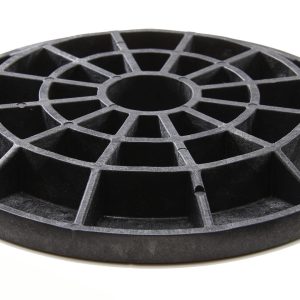
FootingPad® Composite Footing Pads

FootingPad® composite footing pads carry the same load as a poured or precast concrete footing of the same size, without the mixing, the delivery truck, or the multi-day cure. Set it in the hole, build on it the same day, and move on to the next post. Every size is ICC-ES code compliant (ESR-2147) for IBC and IRC projects, so your inspector is covered too.

Five sizes fit any post on your job site. Find yours below and add it straight to your order, or browse the full range of post frame building supplies if your project needs more than footings.

Benefits of FootingPad®


A Smarter Alternative to Concrete Footings

Footing Pad wood post installation

Concrete footings work by spreading a post’s load across enough soil to stop it from settling — that’s exactly what FootingPad does, using a fiber-reinforced composite instead of poured or precast concrete. You get the same engineered performance without batching a single bag: independent lab testing backs FootingPad to match or beat the load capacity of a concrete footing at the same diameter, and it ships ready to drop straight into the hole.

New to composite footings? Our guide on what FootingPad® post footings are and how they work walks through the full comparison against poured concrete.

The Right Fit for Every Post


SizeFits PostsCommon Uses
 FP10 – 10″    4×4 and larger    Fences, light posts, small deck footings
 FP12 – 12″    4×4 and larger    Deck posts, porches, gazebos
 FP16 – 16″    6×6 and larger    Post-frame building columns, larger decks
 FP20 – 20″    6×6 and larger    Pole barns, heavier structural loads
 FP24 – 24″    6×6 and larger    Largest structures, lower-bearing-capacity soils

Get it right the first time. The best size depends on your structure’s load and your soil’s bearing capacity, looser or sandy soil generally calls for a larger pad than dense clay under the same load. Call 800-798-5562 or contact us and we’ll help you spec it out. If you’re weighing composite against precast, compare the rest of our foundation bases and footing pads side by side.


From Pole Barns to Backyard Decks

Contact Us

From Hole to Post in Minutes

FootingPad post footing shown during installation

Set it, center your post, backfill, that’s the whole job. No forms, no mixer, no waiting on a cure. FootingPad works under treated wood posts, Perma-Column® precast columns, laminated and glulam wood columns, and poured or tube-form columns, so switching to FootingPad doesn’t change anything else about how your crew already builds. Anchoring to an existing slab or formed wall instead? Sturdi-Wall® concrete anchor brackets handle that side of the connection.

Still Have Questions?

Is a FootingPad actual concrete? No. It’s a fiber-reinforced composite engineered to match a concrete footing’s performance at the same size, without the weight, the wait, or the truck.

Is FootingPad code-compliant? Yes. It’s independently tested and holds ICC-ES Evaluation Report ESR-2147 for IBC and IRC compliance. Bring a copy for inspectors who haven’t worked with it before.

Can I use FootingPad for a pole barn? Yes, it’s commonly used under post-frame building columns, including Perma-Column®, treated wood, and laminated posts. For the bigger picture, see our breakdown of the best foundation for post-frame buildings.

Do I need to mix concrete to install one? No. Set it in the hole and build the same day, no mixing, no cure time, no wasted trip.

How does the cost compare to pouring concrete? Material cost is only part of the picture once you factor in labor, cure time, and lost days. Our cost comparison of Perma-Column and traditional alternatives breaks down where the savings actually come from.


Build Faster, Starting Today

Every FootingPad ships ready to install, no delivery trucks, no curing, no lost days on the job site. Pick your size above and get building, or explore the full Midwest Perma-Column product line to round out your foundation order.